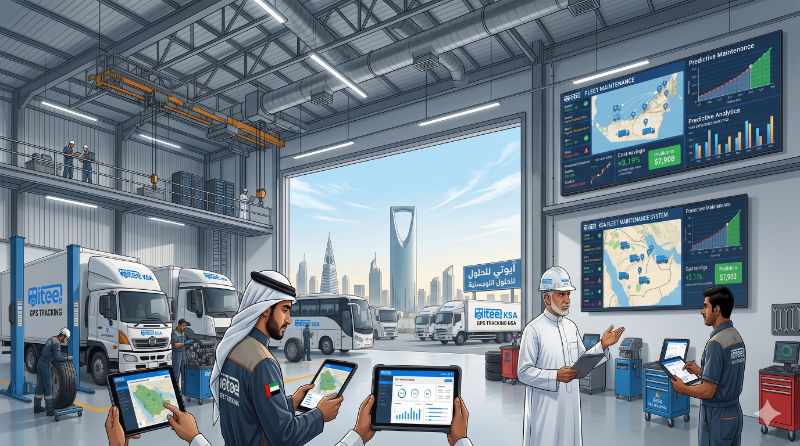
Fleet maintenance in Saudi Arabia is not the same operating problem as fleet maintenance in Germany or the UK. The temperature differential is 30°C in summer, dust loading on filters is 5–10× higher, urban duty cycles are stop-start with long idling, and the manufacturer service intervals printed in the operator manual were calibrated for moderate climates. Following them line-by-line in KSA leaves rubber, fluids, and filters stressed beyond their design point — and a fleet manager wondering why brake pads, batteries, and A/C compressors fail well before the official end-of-life.
This guide is the operating playbook IOTee uses across 320,000+ commercial vehicles in the Kingdom. It is opinionated, KSA-specific, and built around the question every fleet manager actually asks: "how do I cut downtime and maintenance cost without taking on more risk?" The honest answer is a combination of climate-adjusted intervals, the right maintenance strategy mix, predictive maintenance where the data justifies it, and disciplined execution. We break each of those down with real numbers.
The state of fleet maintenance in Saudi Arabia, 2026
Saudi commercial fleets are in the middle of a structural shift. Vision 2030-driven utilisation is up across logistics, construction, food delivery, and passenger transport. Vehicle age is older on average than in 2018 because new-vehicle imports slowed during COVID and never fully caught up. TGA-licensed operators face increasing audit pressure on maintenance records. And labour cost inflation has hit workshop rates and parts pricing simultaneously.
The result: maintenance is a higher share of total cost of ownership than it was three years ago, and reactive maintenance — fixing things after they fail — is more painful because the parts pipeline takes longer and the productivity loss per hour of downtime is larger. The fleets that are pulling ahead are the ones that have moved decisively from reactive to preventive, and from preventive to selectively predictive on the components where the data is reliable.
- Average age of Saudi commercial fleet vehicles in 2026: 6.8 years (vs 5.2 in 2019)
- Median annual maintenance cost per commercial vehicle: SAR 9,400 (light commercial) to SAR 28,000 (heavy)
- Reactive-maintenance share of total maintenance spend on the typical KSA fleet: 38–55%
- Industry-best fleets in KSA push reactive share below 15% — the rest is preventive and predictive
- Top three avoidable failures in KSA: A/C system, battery, and tyre/wheel-bearing
The five fleet maintenance strategies (and which mix to use)
Modern fleet maintenance is not one strategy — it is a mix. Knowing which strategy applies to which component is what separates well-run fleets from ones that overspend. The five strategies, ordered roughly by sophistication:
1. Reactive maintenance
Fix it when it breaks. Cheapest in the short run, most expensive over a fleet lifecycle. Acceptable only for cosmetic items and low-value consumables. Every commercial fleet has some reactive component — the goal is to get it below 15% of total maintenance spend, not to eliminate it.
2. Preventive maintenance
Service on a schedule — typically time, mileage, or engine hours. The workhorse of fleet maintenance. Done right, preventive maintenance prevents 70–80% of avoidable failures. The two failures of preventive maintenance in KSA are (a) using the manufacturer's temperate-climate intervals unchanged, and (b) lack of discipline — services slip past their due dates because the scheduling system is a spreadsheet that no one updates.
3. Condition-based maintenance
Service when sensor data crosses a threshold rather than on a calendar. Tyres replaced at a specific tread depth, oil changed when oil-quality sensors flag degradation, brake pads replaced when wear sensors trigger. This is preventive maintenance with the timing optimised by sensor data. Lower waste, higher discipline required.
4. Predictive maintenance
Use telematics, OBD-II diagnostics, and historical patterns to predict failure before it happens. The component that gets the most return from predictive in KSA: batteries (because heat shortens life unpredictably). After batteries: A/C compressors, alternators, and turbocharger assemblies. Predictive does not work uniformly across all components — it works where the failure mode produces measurable signals 30+ days in advance.
5. Prescriptive maintenance
The frontier. AI systems not only predict failure but recommend the specific intervention, sequence the work optimally, route the vehicle to the closest workshop with parts in stock, and price the job. Few KSA fleets are operating at this level today; the technology is real but the data prerequisites are demanding. We expect prescriptive to become mainstream by 2028.
Climate-adjusted service intervals for Saudi Arabia
Manufacturer service intervals assume a duty cycle that does not exist in Saudi Arabia. Sustained ambient temperatures above 45°C, road-surface temperatures above 70°C in summer, fine-particulate dust loading on intake systems, and high A/C duty cycles all accelerate component wear. The honest engineering answer: shorten most intervals 20–35%. Specific guidance for the components that suffer most:
| Component | Manufacturer interval | KSA-adjusted interval | Why |
|---|---|---|---|
| Engine oil (synthetic) | 15,000 km / 12 mo | 10,000 km / 6 mo | Heat accelerates oxidation; dust contamination |
| Air filter | 40,000 km | 20,000–25,000 km | Sand and dust loading is 5–10× European baseline |
| A/C system service | Bi-annual | Annual + pre-summer top-up | Sustained 100% duty cycle May–September |
| Battery test | Annual | Bi-annual + pre-summer load test | Heat halves typical lead-acid life |
| Coolant flush | 5 years / 240,000 km | 3 years / 150,000 km | Heat degrades inhibitors faster |
| Brake fluid | 2 years | 18 months | Hygroscopic absorption higher in coastal humidity |
| Tyre rotation | 10,000 km | 7,500 km | Hot-asphalt wear pattern is asymmetric |
| Cabin air filter | 20,000 km | 12,000 km | Dust ingress in cabin much higher |
Two notes on the table. First: these are general benchmarks; vehicles in genuinely abusive environments (mining, oil and gas off-road, summer NEOM construction) need shorter intervals still. Second: a maintenance management platform should let you set climate-adjusted templates per vehicle class and apply them automatically — manual interval management on a 50-vehicle fleet is impossible to keep current.
The top failure modes on Saudi fleets and how to prevent them
Across 320,000+ vehicles in our installed base, the same failure modes account for the majority of unplanned downtime in KSA. Knowing which they are lets you target preventive and predictive effort where it pays back fastest.
A/C system failure (≈22% of summer downtime)
The single biggest cause of summer driver complaints and breakdowns. Compressor seizure, refrigerant loss, condenser fouling from dust, and clogged cabin filters compound rapidly under sustained 45°C+ ambient. Preventive measures: annual full A/C service in March/April before peak, monthly visual inspection of the condenser fins for dust caking, cabin filter replacement every 12,000 km. Predictive measures: monitor A/C compressor current draw via OBD — a rising trend indicates bearing degradation 30–60 days before failure.
Battery failure (≈18% of unplanned downtime)
Heat halves typical battery life. A 5-year battery in Munich is a 30-month battery in Riyadh. Preventive measures: load-test every six months, replace proactively at month 30 rather than waiting for failure, prefer AGM or EFB chemistry over flooded lead-acid in heavy-duty service. Predictive measures: monitor cranking voltage from telematics — a downward trend below baseline predicts failure 14–28 days in advance.
Tyre and wheel-bearing failure (≈15% of unplanned downtime)
Hot asphalt accelerates tyre degradation; long-haul highway work amplifies it. The most expensive tyre failures are blowouts on highway segments, which damage rims and wheel bearings simultaneously. Preventive: rotate every 7,500 km, monitor pressure weekly, replace below 3mm tread depth. Predictive: TPMS data trends predict slow leaks 7–14 days before they become emergencies.
Brake system wear (≈12% of unplanned downtime)
Stop-start urban duty cycles in Riyadh and Jeddah produce brake wear rates 2–3× highway-only fleets. The two failure modes: pad-to-rotor wear (predictable, preventable) and brake-fluid degradation (less visible, more dangerous). Preventive: visual inspection at every service, fluid replacement every 18 months, rotor replacement at the second pad change. Predictive: harsh-braking events from telematics correlate strongly with accelerated brake wear — drivers with harsh-braking scores in the top quartile burn pads twice as fast.
Cooling system failure (≈10% of unplanned downtime)
The fifth-most-common KSA failure category. Coolant inhibitors degrade faster in heat; thermostat and water-pump failures cluster in summer. Preventive: coolant flush every 3 years rather than 5, water-pump replacement at the timing-belt service interval, thermostat inspection at every major service. Predictive: coolant temperature trends from OBD — a vehicle running 5–8°C hotter than its baseline indicates impending issue.
Predictive maintenance: where it works and where it does not
Predictive maintenance is the most over-marketed, under-deployed capability in fleet management today. The claim — "AI predicts failure before it happens" — is true in narrow domains and misleading in broad application. The honest framework:
Where predictive works in KSA: components that produce measurable telematics signals 30+ days before failure. Batteries (cranking voltage), A/C compressors (current draw), alternators (output voltage), engine oil (pressure trends), turbochargers (boost-pressure curves). All of these have well-understood degradation signatures that OBD-II and CAN-bus data captures reliably.
Where predictive fails in KSA: components whose failure mode is sudden — broken belts, water-pump bearing seizure, transmission solenoid faults, electrical shorts. The signals these produce arrive too close to failure to act on. For these components, preventive replacement at the manufacturer interval (or shorter, climate-adjusted) is the right strategy.
The ROI math for fleet maintenance investment
Most fleet managers struggle to articulate the ROI of moving from reactive to preventive-plus-predictive. Here is the framework we use, with realistic numbers for a typical 50-vehicle KSA commercial fleet in 2026:
| Cost category | Reactive baseline (per vehicle/yr) | After preventive + predictive (per vehicle/yr) | Annual saving |
|---|---|---|---|
| Routine maintenance spend | SAR 4,200 | SAR 5,100 | (SAR 900) |
| Emergency repair spend | SAR 6,800 | SAR 1,400 | SAR 5,400 |
| Downtime productivity loss | SAR 5,200 | SAR 1,200 | SAR 4,000 |
| Towing and recovery | SAR 800 | SAR 150 | SAR 650 |
| Premature replacement | SAR 2,400 | SAR 600 | SAR 1,800 |
| Total cost | SAR 19,400 | SAR 8,450 | SAR 10,950 |
The takeaway: routine maintenance spend goes up when you move from reactive to preventive (you do more services proactively) but every other category goes down sharply. The net annual saving of SAR 10,950 per vehicle on a 50-vehicle fleet is SAR 547,500 per year — and the platform cost to deliver it is typically SAR 60,000–90,000 per year. The math is not subtle.
For the GPS half of the story (which directly enables maintenance scheduling through real-time odometer and engine-hour readings) see our GPS tracking ROI guide. For the broader fleet management ROI picture, see best fleet management companies in Saudi Arabia 2026.
Choosing fleet maintenance software in Saudi Arabia
A maintenance management platform is the operational backbone — without it, fleets above ~25 vehicles cannot keep climate-adjusted intervals current, parts inventory accurate, and work-order discipline tight. The shortlist criteria that matter most:
- Native GPS/telematics integration. If your maintenance system requires manual odometer entry, intervals will slip. The platform must read odometer, engine hours, and DTC codes directly from the GPS device. This is where IOTee's fleet maintenance system integrates natively with our GPS tracking.
- Climate-adjusted templates. The platform should ship with KSA-tuned service templates out of the box, not require you to build them.
- Bilingual technician interface. Workshop staff in KSA work in Arabic. A platform that is English-only creates friction at exactly the wrong layer.
- Parts inventory with reorder automation. Half of maintenance delay is "we are waiting for the part." A platform that tracks inventory in real time and triggers reorder before stock-out is the single biggest downtime reducer.
- Work-order audit trail. TGA-licensed operators face audit on maintenance discipline. Photo-documented, time-stamped work orders are increasingly the audit baseline.
- Cost analytics by vehicle. The platform should answer "which 3 vehicles are costing me 40% of my maintenance budget" without an analyst writing custom reports.
- Predictive on the right components. Look for vendor honesty about which components are predictive-ready in KSA conditions, not blanket AI marketing.
A 90-day implementation playbook
Most maintenance-system rollouts fail not because the software is bad but because implementation is incomplete. A reliable 90-day playbook:
- Days 1–14 — audit. Inventory every vehicle, capture current mileage and engine hours, document maintenance history, identify the top 3 cost-driver vehicles. The audit phase is unglamorous but it determines everything that follows.
- Days 15–30 — install GPS / OBD readers on every vehicle. Without telematics, the maintenance system is operating blind. This is where vehicles enter the data layer.
- Days 31–45 — set up climate-adjusted maintenance templates. Build templates per vehicle class (light commercial, medium, heavy, specialty) using the climate-adjusted intervals from the table above as a starting point.
- Days 46–60 — train the workshop team. Two-hour platform training for technicians, four-hour training for the workshop manager, escalation protocols documented. In Arabic, with bilingual reference materials.
- Days 61–75 — process the maintenance backlog. Most fleets have a backlog of overdue services after audit. Burn through it methodically before declaring "live."
- Days 76–90 — go live and measure. Run the system fully for 30 days, measure: overdue services, parts stock-outs, average work-order completion time. Adjust templates and processes based on what you learn.
Fleets that follow this playbook typically see their reactive-share fall from 45–55% baseline to under 25% within six months, and under 15% within twelve months.
Saudi compliance touchpoints fleet maintenance must support
Fleet maintenance in KSA is increasingly intertwined with regulatory compliance. The four touchpoints every commercial operator needs to handle:
- TGA operator licensing — passenger and freight transport operators must demonstrate maintenance discipline at audit. Maintenance records, work orders with technician signatures, and parts traceability are core evidence.
- Periodic Motor Vehicle Inspection (Fahas) — annual safety and emissions inspection. A maintenance management system that surfaces upcoming Fahas dates and ensures the vehicle is ready (brakes, lights, emissions) avoids the most expensive inspection failure: a vehicle pulled from service for re-inspection.
- SASO standards on commercial vehicles — replacement parts must meet SASO certification for commercial use. The maintenance system should record part SKU and SASO compliance for audit.
- Wasl Platform telemetry — TGA's Wasl Platform receives operational telemetry from licensed fleets. While Wasl is GPS-focused, maintenance-driven downtime increasingly affects Wasl-reported on-time performance and operator reliability scores.
Ready to move from reactive to preventive-plus-predictive?
IOTee has implemented the playbook in this guide across 320,000+ vehicles in Saudi Arabia. Send us your fleet size and vehicle types and we will return a 90-day implementation plan, climate-adjusted maintenance templates per vehicle class, and a realistic ROI estimate within 24 hours. No commitment.
Explore IOTee Fleet Maintenance →Common reasons fleet maintenance programs fail in KSA
After working with hundreds of Saudi fleets, the failure modes are consistent. If you see your operation in any of these, that is the first thing to fix:
- Manual odometer entry. Whoever is responsible for entering mileages from the dispatcher logs eventually slips, and intervals slip with them. Telematics-driven odometer is non-negotiable above 25 vehicles.
- Manufacturer intervals copied without adjustment. The single most common KSA mistake. Climate-adjust or accept higher failure rates.
- No workshop accountability. Work orders close without photos, parts SKUs, or technician sign-off. Audit trails do not exist. Quality slips silently.
- Parts inventory in a spreadsheet. Stock-outs cause 30–50% of avoidable downtime. The fix is real-time inventory with reorder automation, not better spreadsheets.
- "Predictive maintenance" without telematics. Predictive without OBD/CAN-bus data is just preventive with extra steps. Validate that your platform is actually ingesting the right signals.
- No senior accountability. Maintenance discipline degrades fast without a single named owner. The most successful fleets give one person a target ("reactive share under 20%") and the authority to enforce it.
A note on heavy equipment and specialty vehicles
Everything in this guide applies to heavy equipment with two important adjustments. First: engine-hour-based service is the dominant trigger, not mileage — a generator running 14 hours a day in NEOM construction does not move but consumes maintenance capacity. Second: predictive maintenance is far more valuable on heavy equipment because the cost of downtime is multiples higher (a single excavator out of service can stall an entire crew). For specialty fleets — refrigerated logistics, fuel transport, hazardous materials — the climate-adjusted intervals shorten further still, and condition-based monitoring on tank seals, refrigeration compressors, and ATEX-rated electrical systems becomes mandatory rather than optional.
The honest summary
Fleet maintenance in Saudi Arabia in 2026 is not the problem it was in 2018. The toolset is mature, the cost of telematics has fallen 60%, and the playbook described above has been validated across thousands of Saudi fleets. What separates the fleets that capture the savings from the ones that do not is execution discipline — owning the audit, choosing climate-adjusted intervals, integrating telematics natively, holding the workshop accountable, and selectively deploying predictive on the components where it actually works.
For the implementation, see our fleet maintenance management page. For the broader fleet operating model, see fleet management and real-time GPS tracking. For related reading: 12 tactics to reduce fleet fuel costs in KSA, AI in fleet management — what actually works, and best fleet management companies in Saudi Arabia 2026.