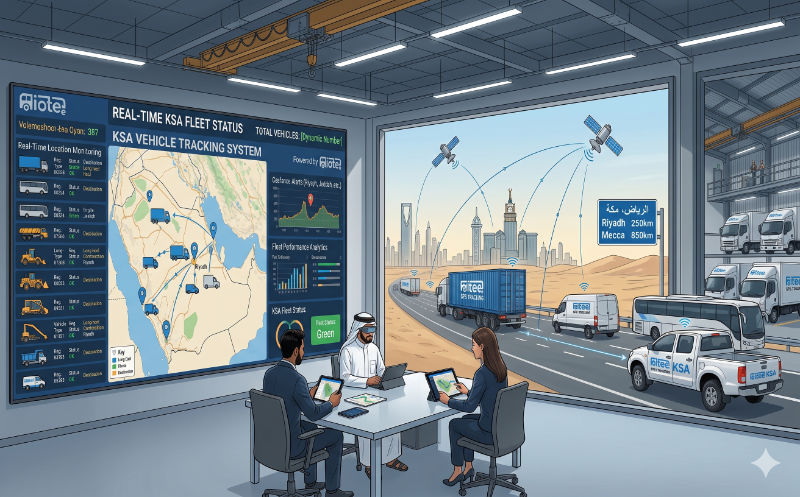
Buying a GPS vehicle tracker in Saudi Arabia has become both easier and harder in 2026. Easier because hardware quality has converged — most reputable trackers now report position to within 2.5 metres and battery devices last weeks rather than days. Harder because the number of vendors selling into the Kingdom has roughly doubled since 2023, and the marketing claims have not kept pace with the technology.
This guide is written for the person actually signing the cheque — a fleet manager, business owner, or operations head — and skips the parts you do not need. It covers the three hardware categories, what each one is genuinely good for, real KSA pricing as of Q2 2026, the MoMRAH and SDAIA rules that affect your purchase, and the seven questions that separate vendors who know what they are doing from vendors selling a glossy dashboard on top of someone else's hardware.
The three GPS tracker categories — what each one actually does
Almost every GPS tracker on the Saudi market in 2026 falls into one of three hardware categories. The right one for your fleet depends on what you are tracking, where it is mounted, and how long the device needs to last between battery charges.
Wired (hardwired) GPS trackers
A wired tracker is permanently installed and powered by the vehicle's 12V or 24V electrical system. It sees ignition state, can read fuel-level sensors, integrates with CAN-bus on commercial vehicles, and runs indefinitely without intervention. This is the workhorse of Saudi fleet tracking — about 78% of commercial vehicles tracked on the IOTee platform use wired devices.
- Best for: commercial fleets, taxis, delivery vehicles, company cars, any vehicle with a constant power source
- Typical install time: 30–45 minutes by a certified technician
- Position accuracy: 2.5–5 metres open sky, 5–15 metres in dense urban areas
- Reporting cadence: every 10 seconds while moving, every 60–120 seconds while parked
- Hardware lifespan: 5–7 years in KSA conditions
OBD-II plug-in trackers
OBD-II trackers plug into the standardized diagnostic port found on virtually every passenger vehicle made after 2008. No installation required — the driver plugs it in and the device powers itself from the OBD port. The trade-off is fragility: they can be unplugged in seconds, they protrude visibly, and they only work on vehicles with OBD-II support (so excluding most heavy commercial vehicles, which use J1939).
- Best for: rental cars, family vehicles, short-term tracking, personal use
- Typical install time: 30 seconds (no technician needed)
- Position accuracy: 2.5–5 metres open sky
- Limitations: easily removed, not suitable for theft-recovery use cases
- Hardware lifespan: 3–5 years (more handling damage than wired)
Battery-powered (wireless) GPS trackers
A battery tracker has its own power supply — typically a sealed lithium pack rated for 1–5 years of operation depending on reporting frequency. They are used wherever you cannot or do not want to wire into a vehicle electrical system: trailers, generators, shipping containers, construction equipment, even art shipments. Modern battery trackers are weatherproof to IP67 and small enough to hide.
- Best for: trailers, containers, generators, construction assets, covert installations
- Typical install time: stick-on or screw-mount, 5 minutes
- Reporting cadence: typically 1–4 times per day to maximise battery life (configurable up to every few minutes for short missions)
- Battery life: 18 months to 5 years depending on reporting cadence and temperature
- KSA-specific note: extreme summer heat in the Eastern Province shortens battery life by 15–25% versus the manufacturer's rating
For asset-focused tracking, see our personal and asset tracking page for examples of where battery trackers earn their place. For full commercial fleet deployments, a wired install is almost always the better economics.
Real Saudi pricing in Q2 2026 — what you should actually expect to pay
Quoted prices from KSA vendors in 2026 vary by 3–4× for what is functionally the same hardware. The variance comes from contract length, included support, software platform quality, and how much the vendor needs to recover from a wholesale-only model. Here are the bands we observe across the market — not theoretical pricing, but actual signed contracts.
| Tracker type | Hardware (one-time) | Software & SIM (per vehicle/month) | Install (one-time) | Total Year-1 cost |
|---|---|---|---|---|
| Wired — entry | SAR 250–400 | SAR 25–40 | SAR 80–150 | SAR 630–1,030 |
| Wired — mid-tier (most popular) | SAR 400–650 | SAR 35–60 | SAR 100–200 | SAR 920–1,570 |
| Wired — premium (CAN-bus, fuel sensor) | SAR 700–1,200 | SAR 60–110 | SAR 200–400 | SAR 1,620–2,920 |
| OBD-II | SAR 200–350 | SAR 25–45 | SAR 0 (self-install) | SAR 500–890 |
| Battery — basic | SAR 350–550 | SAR 15–30 | SAR 0 | SAR 530–910 |
| Battery — long-life (5-year) | SAR 600–950 | SAR 18–35 | SAR 0 | SAR 816–1,370 |
MoMRAH, SDAIA, and the regulatory baseline
Saudi Arabia's regulatory environment for vehicle tracking has evolved meaningfully since 2022. Three things matter for buyers in 2026, and a vendor that cannot speak to all three is either new or hiding something.
- CITC frequency authorisation: any cellular GPS device sold in KSA must use a SIM provisioned through a CITC-licensed operator (STC, Mobily, Zain). Most reputable vendors handle this for you, but ask for written confirmation.
- Personal Data Protection Law (PDPL): driver location is personal data under PDPL when associated with an identified driver. Your contracts must specify retention periods, access controls, and consent procedures. SDAIA publishes the official PDPL implementing rules.
- Data residency: telematics data from Saudi vehicles is increasingly expected to be processed and stored within the Kingdom. Confirm where the dashboard is hosted and where the raw GPS pings land before signing.
For commercial heavy vehicles, also check the Transport General Authority (TGA) requirements specific to your operator licence — for-hire passenger transport, freight, and waste-management licences each have their own tracking and reporting expectations.
The seven questions every Saudi GPS buyer should ask
After advising hundreds of Saudi fleet purchases over the last seven years, this is the question set that separates serious vendors from the rest. Print it, take it to your next vendor meeting, and watch how they answer.
1. Where is my data physically hosted?
Acceptable answers: "in a Saudi data centre" or "in our KSA cloud region with documented residency." Unacceptable answers: "globally distributed," "in the cloud," or any answer that does not name a country. If they cannot tell you, they do not know — and SDAIA expects you to.
2. What is the position-update interval, in seconds, while the vehicle is moving?
Acceptable: 10 seconds or less. Some heavy-vehicle vendors will say 30 seconds — that is acceptable for a long-haul truck but unacceptable for a city-delivery van where 30 seconds is a full block. Watch out for vendors who quote "every 1–10 minutes" — that is asset-tracker performance being sold as fleet-tracker performance.
3. What happens to my data if I cancel the contract?
Acceptable: full historical data export in CSV or API format, available for 30 days after termination. Unacceptable: "we keep the data" or "you would need to start again." Your historical telematics is operational evidence — for insurance, audits, and dispute resolution. Do not sign anything that does not return it to you.
4. What is the SIM-card replacement process?
Cellular networks degrade — 2G is being decommissioned across the GCC, and many older trackers are stranded. Acceptable: 4G/LTE Cat-M1 or NB-IoT, with a defined SIM upgrade path. M2M SIM cards designed for telematics are different from consumer SIMs — they handle roaming, low-data sessions, and device IMEI-locking differently.
5. Who owns the support relationship — you, or your distributor?
Many trackers sold in KSA come from white-label hardware combined with regional distributor software. When something goes wrong at 2am, knowing which company actually answers the phone matters. Ask for the support SLA in writing and ask who fulfils it — the seller, or a third party in another country.
6. Is the dashboard available in Arabic AND English?
Right-to-left support is not optional in KSA in 2026. If you have Arabic-speaking dispatchers, mechanics, or HR teams, the dashboard needs to work properly in Arabic — not just translated strings on a left-to-right layout. Test it during the demo. Test the report export. Test the mobile app.
7. Can the platform integrate with my other systems?
A modern fleet platform should expose a documented API — for ERP integration (SAP, Oracle, Microsoft), payroll, accounting (Zoho, Tally), and HR. If you have an attendance system or workforce management need, the same platform may be able to handle both. Our attendance system and workforce management platform share the same GPS infrastructure for exactly this reason.
How to actually compare two vendors side-by-side
After you have shortlisted two or three vendors, the cleanest way to compare is to ask each one to install a demo device on a single vehicle in your fleet for 14 days. Run that vehicle on its normal route. Then compare the actual data — not the marketing material.
- How many position-update gaps over 60 seconds occurred during the 14 days? (Lower is better; under 0.5% is excellent)
- How accurate were the geofence entry/exit timestamps versus your driver's actual arrival? (Within 30 seconds is good)
- How many false alerts did the system generate, and how many real events did it miss?
- How long does the dashboard take to load in a real Riyadh office network with 50 vehicles on the map?
- Can the platform produce a useful report in under three clicks, or does it require dashboard-engineering?
City-specific considerations across Saudi Arabia
The Kingdom is large enough that a tracker that performs well in Riyadh may struggle in Khobar, and vice-versa. Three regional dynamics matter:
- Riyadh: tall buildings around King Fahd, Olaya, and the financial district create urban canyons that degrade GPS accuracy. Trackers with multi-constellation GNSS (GPS + GLONASS + Galileo + BeiDou) hold position better. See our Riyadh GPS tracking page for region-specific guidance.
- Jeddah: high humidity at the coast accelerates corrosion on poorly-sealed devices. IP67 minimum, IP69K preferred for exposed installations. See Jeddah fleet solutions.
- Dammam, Khobar, Jubail: Eastern Province summer ambient temperatures regularly exceed 50°C inside parked vehicles. Industrial-grade temperature ratings (-30°C to +85°C operating) matter here. See Dammam vehicle tracking for Eastern Province context.
Where the pure-software vendors get tripped up
A growing number of vendors in 2026 sell "GPS tracking software" without owning the hardware — they integrate with whatever device you bring. This sounds appealing (vendor flexibility, cheaper software) but creates a real support problem: when something breaks, the software vendor blames the hardware vendor, who blames the SIM provider, who blames the integrator. By the time it is fixed, you have lost three days of data.
For mission-critical fleets, single-vendor accountability — one company that owns hardware, software, SIM provisioning, installation, and support — typically delivers better outcomes. That is not always cheaper on day one, but it is usually cheaper on day 365.
The hidden costs nobody mentions in the proposal
Watch for these line items that appear after the contract is signed:
- Per-vehicle activation fees: SAR 50–200 per vehicle, sometimes recurring annually
- Driver app licence fees: SAR 5–15 per driver per month — added separately from vehicle fees
- Custom report fees: SAR 200–800 per custom report, billed ad-hoc
- API access fees: SAR 500–2,000 per month for integration access
- Data retention upgrade fees: standard plans often retain only 3–6 months; full historical access can be a paid add-on
- Contract renegotiation fees: some contracts have unilateral price-escalation clauses tied to fuel or currency
Ask for the all-in price, in writing, with every line item enumerated. The vendor that hesitates is the one whose hidden costs are largest.
Want a side-by-side vendor comparison for your specific fleet?
Send us your current vendor proposal (or your fleet size and vehicle types if you are starting from scratch). We will return a no-jargon analysis of where the proposal is competitive, where it is overpriced, and what to negotiate. No sales pressure — we publish this analysis whether you choose IOTee or not.
Get a free vendor proposal review →When should I buy versus wait?
In 2026, the case for waiting is weak. GPS tracker hardware has been incrementally improving for a decade and the gains are now diminishing — a 2026 device is maybe 5–8% better than a 2024 device on most metrics that matter. The case for buying now is stronger: fleet management efficiency gains compound month over month, insurance premium reductions only start accruing once you have 12 months of clean driver data, and waiting another quarter to deploy means another quarter of data loss to recover from.
The exception: if your current trackers are 2G-only, you have a 2026 problem regardless. GSMA tracks the global 2G shutdown; KSA operators are progressing along the same curve. Plan a hardware refresh now, not a replacement under emergency conditions later.
Putting it all together — the 30-minute decision framework
- Define your use case in one sentence: "Track [X] vehicles for [Y] outcome over [Z] years."
- Pick the hardware category: wired for 95% of commercial fleets, OBD for short-term/removable, battery for assets without 12V.
- Set a budget band: mid-tier wired at SAR 35–60 per vehicle per month is the modal answer.
- Shortlist three vendors. Each must answer all seven questions in writing.
- Run a 14-day pilot on one vehicle per vendor.
- Compare actual data, not marketing claims. Sign with the vendor whose numbers held up.
If you want a pre-built shortlist for your specific industry or city, we publish guides for fleet management, real-time tracking, and logistics-specific GPS. Our team handles all three categories of hardware, all major Saudi cities, and all the compliance work end-to-end.