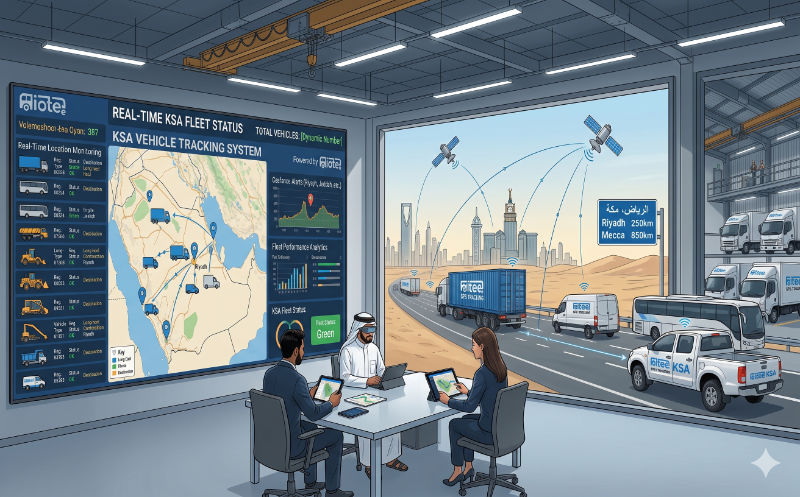
A vehicle tracking system is the single most cost-effective piece of technology a Saudi fleet can deploy in 2026 — and also one of the most misunderstood. Ask ten vendors what a "vehicle tracking system" is and you will get ten answers, ranging from a SAR 150 plug-in dongle to a full telematics platform managing thousands of trucks across the Kingdom.
This guide explains what a vehicle tracking system actually is, how the hardware and software fit together, what the different types cost in Saudi Arabia, and the regulations — TGA, PDPL and SDAIA — that now shape every fleet deployment. It is written for fleet managers, operations heads and business owners who need to make a decision, not a glossary. Where you need to go deeper on hardware, we link to our GPS tracker buyer's guide; where you need the financial case, we link to our GPS tracking ROI breakdown.
What is a vehicle tracking system?
A vehicle tracking system is a combination of hardware and software that continuously records and reports the location, movement and operating status of one or more vehicles. At its simplest it answers "where is my vehicle right now?" In a modern fleet deployment it answers far more: how fast the vehicle is moving, whether the engine is idling, how much fuel is in the tank, how the driver is behaving, and whether the vehicle has entered or left a defined area.
The terms vehicle tracking system, GPS tracking system and fleet telematics are often used interchangeably in Saudi Arabia. There is a useful distinction worth keeping: GPS tracking refers to the location technology itself, while a vehicle tracking system is the complete product — location plus the connectivity, platform and integrations that make that location useful to a business.
The four parts of every vehicle tracking system
Whatever a vendor calls their product, every vehicle tracking system is built from the same four parts. Understanding them is the fastest way to compare vendors honestly.
- The tracking device (GPS/GNSS receiver): the hardware fitted to the vehicle. It receives signals from satellite constellations — GPS, plus GLONASS, Galileo and BeiDou on modern units — to calculate position to within roughly 2.5 metres.
- Connectivity (cellular SIM / M2M): a SIM card that transmits position over the mobile network to the cloud. In the Kingdom this runs on STC, Mobily or Zain coverage; serious fleet devices use multi-network M2M SIMs so they do not go dark when one network drops.
- The telematics platform (software): the web and mobile application where data becomes useful — live maps, trip history, geofences, alerts, driver scores and reports. This is where most of the long-term value, and most of the difference between vendors, actually lives.
- Integrations and alerts: the connections to the rest of the business — fuel sensors, dash cameras, temperature probes, fuel-card data, ERP and payroll systems — plus the SMS, email and push alerts that put a problem in front of a human in real time.
How a vehicle tracking system works
The journey from a satellite signal to a manager's dashboard takes only a few seconds and follows the same five steps in every system.
- The in-vehicle device receives signals from multiple satellite constellations and calculates its exact position, speed and heading.
- The device reads vehicle data — ignition status, battery voltage, and on connected units fuel level, RPM and fault codes from the OBD or CAN bus.
- It packages that data and transmits it over the cellular network, typically every 10–60 seconds while moving and less often when parked.
- The telematics platform receives the data, stores it, and runs it against your rules — speed limits, geofences, idle thresholds and schedules.
- The platform updates the live map and fires any triggered alerts to the fleet manager by app, SMS or email — and writes everything to history for later reporting.
Types of vehicle tracking systems
Vehicle tracking systems are categorised two ways: by how often they report, and by how the device is installed. Both matter for Saudi fleets.
By reporting frequency. Real-time (active) systems stream position continuously and are the standard for any commercial fleet that needs live visibility. Passive systems only log data and reveal it when the vehicle returns to base — cheaper, but useless for dispatch, theft response or live ETAs, so they have all but disappeared from Saudi fleet use.
By installation type. This is the choice that affects price, durability and tamper resistance:
| System type | How it installs | Best for | KSA cost (per vehicle/month) |
|---|---|---|---|
| Hardwired real-time | Wired into 12V/24V power and ignition | Trucks, vans, buses, owned commercial fleets | SAR 35–60 |
| OBD-II plug-in | Plugs into the OBD-II diagnostic port | Light vehicles, short leases, rentals | SAR 30–50 |
| Battery / asset tracker | Self-powered, magnetic or bolted on | Trailers, generators, containers, unpowered assets | SAR 25–55 |
| Smartphone / app-based | Driver's phone, no hardware | Very small fleets, gig drivers, pilots | SAR 10–25 |
For a detailed breakdown of the hardware trade-offs — accuracy, tamper resistance, device lifespan and the seven questions to ask any vendor — see our complete GPS tracker buyer's guide for Saudi Arabia.
The features that matter for Saudi fleets
A vehicle tracking system is only as valuable as the features your team actually uses. These are the eight that consistently move the numbers for Saudi fleets, based on usage across 320,000+ tracked vehicles.
- Live tracking and trip history: see every vehicle on one map in real time, and replay any trip down to the second for disputes, audits or customer proof-of-delivery.
- Geofencing: draw virtual boundaries around depots, customer sites, cities or restricted zones and get alerted the moment a vehicle enters or leaves — the backbone of unauthorised-use detection.
- Driver behaviour monitoring: scoring for speeding, harsh braking, rapid acceleration and cornering — the feature most directly tied to accident reduction and insurance discounts.
- Fuel monitoring: tank-level sensors or OBD data that expose theft, siphoning and excessive idling. In the Kingdom this is often the single largest line of recovered cost.
- Speed and curfew alerts: automatic flags when a vehicle exceeds a set speed or moves outside permitted hours — important for both safety and TGA-regulated operations.
- Dash-cam integration: linking video to GPS events so a harsh-braking alert arrives with footage, roughly halving accident-dispute resolution time.
- Maintenance scheduling: service reminders driven by real odometer and engine-hour data rather than guesswork, cutting breakdowns and extending vehicle life.
- Arabic-first reporting and dashboard: not a nice-to-have in the Kingdom. A platform your dispatchers and drivers cannot read in Arabic will not be used — and an unused system saves nothing.
What a vehicle tracking system costs in Saudi Arabia (2026)
Pricing for vehicle tracking in Saudi Arabia falls into clear tiers. The monthly subscription is what most buyers focus on, but total cost of ownership also includes hardware, installation and SIM/data.
| Tier | What you get | Typical KSA price |
|---|---|---|
| Entry | Basic real-time location, geofencing, mobile app | SAR 25–35 / vehicle / month |
| Standard | Above + driver scoring, fuel and idle reports, alerts | SAR 35–50 / vehicle / month |
| Advanced | Above + dash-cam, fuel sensors, API/ERP integration, dedicated support | SAR 50–90 / vehicle / month |
| Hardware (one-time) | Device + installation, per vehicle | SAR 150–600 one-time |
Saudi regulations every fleet must know
Vehicle tracking in Saudi Arabia is no longer purely an operational choice. For several categories of fleet it is a regulatory requirement, and for all fleets the driver-location data it generates is now governed by national data-protection law. Four bodies matter.
- Transport General Authority (TGA / هيئة النقل): the TGA regulates commercial transport in the Kingdom and requires operators in regulated categories — heavy trucks for hire, buses, leased and certain logistics vehicles — to fit approved tracking and telematics. If you operate under a TGA licence, confirm your system meets its technical requirements before you buy.
- Personal Data Protection Law (PDPL): a driver's real-time location is personal data. Under the PDPL you need a lawful basis to collect it, you must tell drivers what you track and why, and you cannot keep the data longer than necessary. Tracking employees without disclosure is a compliance risk, not just an HR one.
- Saudi Data & AI Authority (SDAIA): SDAIA oversees the PDPL and national data governance. Its guidance pushes fleets toward clear retention policies and, increasingly, toward keeping Saudi personal data hosted inside the Kingdom.
- MoMRAH and municipal rules: for some municipal, waste and delivery activities, local authorities require tracking as a condition of the operating permit. Check the terms of your specific activity licence.
Vehicle tracking by fleet type
The right configuration of a vehicle tracking system depends on what you move and where. These patterns recur across Saudi fleets.
- Logistics and distribution: live ETAs, route optimisation and proof-of-delivery; the priority is dispatch visibility and fuel control across long Kingdom routes. See logistics tracking.
- Construction and heavy equipment: asset trackers on unpowered machinery, engine-hour-based maintenance, and theft recovery for high-value equipment on remote sites.
- Cold chain and food delivery: temperature probes tied to location, so a refrigeration failure is flagged with the exact vehicle and the spot it happened.
- Rental and leasing: OBD or hidden trackers for return verification, mileage billing and recovery of overdue vehicles. See GPS tracking for rental cars.
- Passenger and school transport: TGA-compliant tracking, speed and curfew alerts, and parent or operator visibility for safety.
- Government and municipal fleets: service-area geofencing, utilisation reporting and audit-grade trip history.
How to choose a vehicle tracking system
Once you know the type and features you need, choosing a vendor comes down to a short, hard-nosed checklist.
- Confirm the system reports in true real time (10–60 second updates), not every few minutes.
- Check the platform and reports are available in Arabic, and that drivers get an Arabic app.
- Ask where the data is hosted and how long it is retained — confirm PDPL alignment.
- Verify the device is tamper-evident and reports when it is unplugged or loses power.
- Get the three-year total cost in writing: hardware, installation, subscription and SIM/data.
- Ask for a reference fleet of similar size and activity in the Kingdom — and call it.
- Run a 10-vehicle pilot for 30 days before committing the whole fleet.
Comparing vendors? Our guide to the best fleet management companies in Saudi Arabia and our page on the best tracking company in KSA walk through the shortlist.
Rolling out a vehicle tracking system: a 30-day plan
- Days 1–5 — Baseline: record current fuel spend, payroll hours and incident rates so you can prove the savings later.
- Days 6–10 — Pilot install: fit 10 vehicles, brief the drivers, and issue the written privacy notice.
- Days 11–20 — Configure: set geofences, speed limits, idle thresholds and the three reports your managers will actually open.
- Days 21–25 — Review the pilot data, fix the false alerts, and confirm the platform answers your real questions.
- Days 26–30 — Roll out fleet-wide, train dispatchers, and schedule a 90-day savings review against the baseline.
Common mistakes Saudi fleets make
- Buying on monthly price alone and ignoring hardware, lock-in and data charges.
- Choosing a platform with no Arabic interface, then wondering why nobody uses it.
- Skipping the driver privacy notice and triggering avoidable pushback and PDPL exposure.
- Installing the system and never assigning anyone to act on the alerts.
- Picking passive logging to save a few riyals, then having no live visibility when a vehicle is stolen.
- Not baselining before install, so the savings can never be proven to the CFO.
See a vehicle tracking system built for Saudi fleets
IOTee runs real-time tracking, fuel monitoring, driver scoring and Arabic-first reporting across 320,000+ vehicles in the Kingdom. Book a free demo and we will map it to your fleet.
Request a free demo →Vehicle tracking across Saudi Arabia
IOTee deploys and supports vehicle tracking systems Kingdom-wide. Explore tracking in Riyadh, Jeddah, Dammam, Makkah, Madinah and Khobar.