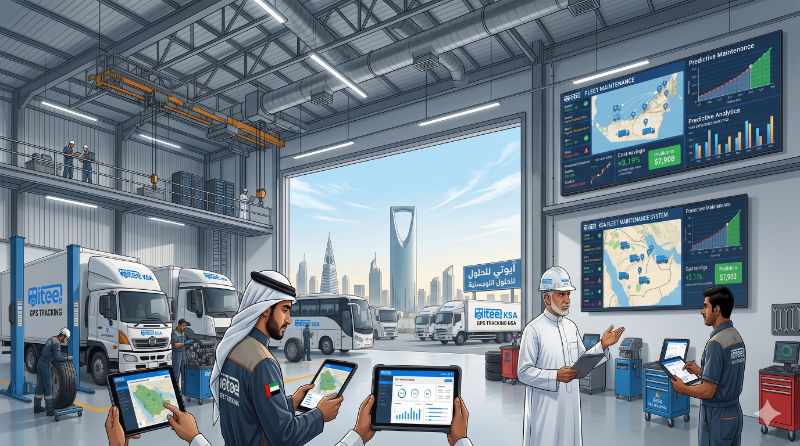
Every Saudi fleet already does maintenance. The question in 2026 is whether a system runs it, or whether it runs on a workshop manager's memory, a WhatsApp group and a spreadsheet that is always one version out of date. A fleet maintenance system is the software that turns maintenance from a reactive scramble into a scheduled, costed, auditable process — and it is the difference between a vehicle that fails on a Riyadh ring road in August and one that was serviced the week before.
This guide is about the system, not the strategy. For maintenance strategies, climate-adjusted service intervals, failure modes and the ROI math, read our complete fleet maintenance guide for Saudi Arabia. Here we cover what a fleet maintenance system actually is, the modules it runs, how the work-order workflow operates day to day, what the software costs in the Kingdom, and how to choose one without buying shelfware.
What is a fleet maintenance system?
A fleet maintenance system is software that plans, executes and records all maintenance and repair activity across a fleet of vehicles or equipment. It holds the full service history of every asset, tells you what is due and when, turns that into work orders, tracks the parts and labour consumed, and reports what each vehicle costs to keep on the road.
The terms vary. A CMMS (computerised maintenance management system) is the general category. Fleet maintenance software is a CMMS specialised for vehicles. Fleet maintenance management is the practice the software supports. In the Kingdom the most capable systems in 2026 are telematics-integrated — the maintenance module and the GPS tracking platform are one product, so odometer, engine-hours and fault codes flow in automatically instead of being typed by hand.
The core modules of a fleet maintenance system
However it is branded, a real fleet maintenance system is built from the same modules. If a vendor is missing two or more of these, it is a tool, not a system.
- Asset register: every vehicle and piece of equipment with its plate, VIN, Istimara, specs, warranty and complete service history in one record.
- Preventive maintenance (PM) scheduling: service rules by distance, time or engine hours that fire automatically — the engine of the whole system.
- Work orders: the job ticket — fault, assigned technician or garage, parts, labour hours, photos, cost and status from open to closed.
- Parts and inventory: stock levels, reorder points and parts cost per job, so a service is not delayed waiting for a filter that was never ordered.
- Vendor and garage management: in-house workshop and external garages, their rates, turnaround and quality, tracked over time.
- Reporting and dashboards: cost per vehicle, cost per kilometre, downtime, PM compliance and the worst-performing assets.
- Telematics integration: the live feed of odometer, engine hours and diagnostic trouble codes (DTCs) from the GPS device — the feature that separates a modern system from a digital logbook.
How a fleet maintenance system works (the workflow)
The value of a fleet maintenance system is the workflow it enforces. The same six-step loop runs for every service and repair, and the system never lets a step be skipped or forgotten.
- Trigger: a PM rule comes due (e.g. 10,000 km reached), a fault code arrives from the telematics device, or a driver reports a defect from the app.
- Work order created: the system opens a ticket with the asset, the fault, the recommended parts and the priority.
- Assign and schedule: the job is assigned to a technician or external garage and slotted to minimise the vehicle being off the road.
- Parts reserved: required parts are checked against inventory and reserved, or a reorder is raised automatically.
- Execute and record: the technician completes the work in the mobile app, logging labour hours, parts used and before/after photos.
- Close and analyse: the work order closes, the service history and cost update, and the data feeds the dashboards that drive the next decision.
Spreadsheets vs CMMS vs telematics-integrated systems
Saudi fleets run maintenance one of three ways. Knowing which tier you are on — and which to move to — is the first decision.
| Approach | How it works | Best for | Where it breaks |
|---|---|---|---|
| Spreadsheets / paper | Manual logs, reminders in someone's head | Under ~10 vehicles, one location | Missed services, no cost visibility, data lost when staff leave |
| Standalone CMMS | Dedicated maintenance software, data entered manually | 10–50 mixed vehicles and equipment | Odometer/hours typed by hand drift from reality; no live fault data |
| Telematics-integrated system | Maintenance module fed live by the GPS/telematics platform | Any commercial fleet that already tracks vehicles | Requires trackers fitted; best value when tracking is already in place |
For most Saudi commercial fleets that already run GPS, the telematics-integrated system is the obvious answer: the data that drives maintenance — distance, engine hours, harsh-use events, fault codes — is already being collected. Bolting a separate maintenance tool alongside it just re-creates the manual data-entry problem the system is supposed to remove. See how the underlying data is captured in our vehicle tracking system guide.
The features that matter for Saudi fleets
A fleet maintenance system earns its cost through a handful of features that fleets actually use. These are the eight that move downtime and cost numbers for Saudi operators.
- Usage-based PM scheduling: service triggered by real kilometres or engine hours from the tracker, not a fixed calendar — the single highest-impact feature in a hot, high-mileage market.
- Fault-code (DTC) alerts: the system reads diagnostic trouble codes live and opens a work order before a warning light becomes a breakdown.
- Technician mobile app: mechanics close jobs, log parts and add photos from the workshop floor — paperwork that never reaches a desk never gets entered.
- Parts inventory and reorder: stock tracking with automatic reorder points so the filter, belt or battery is on the shelf when the vehicle arrives.
- Cost-per-vehicle and cost-per-km reporting: the report that exposes the money pit in the fleet and justifies replacement decisions to finance.
- Downtime and PM-compliance tracking: how much each vehicle is off the road and what share of scheduled services actually happened on time.
- Istimara and periodic-inspection reminders: automatic alerts for vehicle registration (Istimara) renewal and Motor Vehicle Periodic Inspection (Fahas / MVPI) so no vehicle runs out of compliance.
- Arabic interface and offline mode: an Arabic app for technicians and offline capture in low-signal workshops — without both, adoption on the workshop floor stalls.
What fleet maintenance software costs in Saudi Arabia (2026)
Fleet maintenance software in the Kingdom is priced per vehicle per month, usually in tiers, and is frequently bundled into a telematics subscription rather than billed separately.
| Tier | What you get | Typical KSA price |
|---|---|---|
| Add-on to telematics | PM scheduling and work orders inside your GPS platform | SAR 5–15 / vehicle / month |
| Standalone fleet software | Full CMMS: assets, PM, work orders, parts, reports | SAR 15–30 / vehicle / month |
| Advanced / integrated | Above + DTC alerts, inventory, ERP integration, predictive features | SAR 30–40 / vehicle / month |
| Setup (one-time) | Data migration, asset onboarding, training | SAR 0–250 per vehicle |
Integrations that make a fleet maintenance system worth it
A fleet maintenance system in isolation is a tidy database. Its value compounds through what it connects to.
- GPS / telematics: live odometer, engine hours and fault codes — the difference between scheduled-by-calendar and scheduled-by-reality. See real-time GPS tracking.
- Fuel monitoring: a sudden drop in fuel economy is an early maintenance signal — clogged filters, dragging brakes, tyre pressure.
- Dash cameras: harsh-use and impact events flag vehicles that need an unscheduled inspection.
- ERP and accounting: maintenance cost flows into the books and the total-cost-of-ownership picture without re-keying.
- Fuel cards and parts suppliers: automated cost capture and faster reordering.
Build vs buy: should you develop your own?
Larger Saudi fleets sometimes ask whether to build a maintenance system in-house. For almost all of them, buying wins.
- Buy when you want value in weeks, not a year; when you need the telematics integration already built; and when you do not want to own the maintenance, security and updates of bespoke software forever. This is over 95% of fleets.
- Build (or heavily customise) only when your maintenance process is genuinely unusual, you have a dedicated software team, and integration with proprietary internal systems is a hard requirement. Even then, most fleets are better served by a configurable platform with an open API.
How to choose a fleet maintenance system
Once you know the tier you need, the vendor choice comes down to a short checklist.
- Confirm it integrates with your GPS/telematics so odometer and engine hours flow in automatically.
- Check there is a real technician mobile app in Arabic, with offline capture for low-signal workshops.
- Verify PM rules can be set by distance, time and engine hours — not time alone.
- Ask whether it reads diagnostic fault codes (DTCs) and opens work orders from them.
- Confirm it tracks Istimara and periodic-inspection (Fahas) dates and alerts before expiry.
- Get the per-vehicle cost in writing, including setup, and confirm whether it is bundled with tracking.
- Run a 30-day pilot on one workshop and one vehicle group before fleet-wide rollout.
Rolling out a fleet maintenance system: a 30-day plan
- Days 1–7 — Build the asset register: load every vehicle with plate, VIN, Istimara and current odometer; import history where you have it.
- Days 8–14 — Set PM rules: define service intervals by distance and engine hours, and connect the telematics feed so they update automatically.
- Days 15–21 — Pilot one workshop: run live work orders, train technicians on the mobile app, and fix the rules that fire too often or too late.
- Days 22–26 — Wire integrations: GPS, fuel, and accounting; confirm costs and odometer reconcile with reality.
- Days 27–30 — Roll out fleet-wide, set the weekly cost-and-downtime review, and assign an owner for overdue work orders.
Common mistakes Saudi fleets make
- Buying maintenance software that does not talk to the GPS system, then typing odometer readings by hand.
- Scheduling everything on a fixed calendar in a market where one vehicle does 4× the mileage of another.
- Choosing a system with no Arabic technician app and wondering why the workshop ignores it.
- Tracking work orders but never opening the cost-per-vehicle report that justifies the whole investment.
- Forgetting Istimara and periodic inspection until a vehicle is pulled off the road for an expired registration.
- Migrating no history at all, so the system starts blind to which vehicles are already problems.
See a fleet maintenance system built into your tracking
IOTee runs maintenance scheduling, work orders, fault-code alerts and Arabic-first technician tools on the same platform that tracks 320,000+ vehicles in the Kingdom. Book a free demo and we will map it to your fleet.
Request a free demo →Fleet maintenance across Saudi Arabia
IOTee deploys fleet maintenance and tracking together, Kingdom-wide. Explore our fleet maintenance service, or fleet support in Riyadh, Jeddah, Dammam, Makkah, Madinah and Khobar.