If your vehicles move goods or people for money in Saudi Arabia, you are operating inside a regulated activity — and the regulator is the Transport General Authority (TGA), الهيئة العامة للنقل. TGA licenses transport operators, defines who may run a commercial fleet and under what conditions, and is steadily raising the bar on record-keeping, tracking and driver standards as part of the Kingdom's National Transport and Logistics Strategy under Vision 2030. Compliance is no longer a folder of paper renewed once a year; it is an operating condition that can be checked at any time.
This guide explains, in plain terms, what TGA compliance means for a fleet in 2026: the licensing and operating cards a commercial vehicle needs, where the Mawthooq (موثوق) operator-accreditation programme fits, the documents and records an inspection expects, and — the part most operators underestimate — how a telematics platform turns compliance from an annual panic into a background process. Because requirements are updated by the authority, treat every specific below as a starting point and confirm the current rules and fees on the official TGA channels before you act.
What is the TGA and who has to comply?
The Transport General Authority is the government body responsible for regulating and licensing transport activities — land (freight and passenger), maritime and railway — across the Kingdom. For fleet operators, "TGA compliance" almost always concerns land transport: trucking and freight, bus and passenger transport, and app-based passenger transport.
You are very likely within TGA's scope if your fleet does any of the following:
- Freight transport for others: moving goods commercially, including general freight, heavy haulage and, in many cases, own-account transport above certain thresholds.
- Passenger transport: buses, coaches, staff and school transport contractors, and tourism transport.
- App-based / directed passenger transport: ride-hailing and similar services, which carry their own tracking and driver-accreditation conditions.
- Specialised transport: such as certain hazardous-goods or heavy-equipment movements, which add further conditions on top of the base licence.
A private company car that never carries goods or paying passengers is a different matter — but the moment a vehicle earns money by moving something, assume TGA rules apply and check the specific activity. If you also run heavy vehicles, pair this with our guide to the mandatory speed-limiter regulation, which is enforced alongside operator licensing.
Where the Mawthooq programme fits
Mawthooq (موثوق, literally "trusted") is a TGA programme oriented around verifying and accrediting transport operators — giving customers, contractors and the authority confidence that an operator meets the required standards. In practice, operator-accreditation programmes like this reward fleets that keep their licensing, vehicles, drivers and records in order, and they penalise those that do not.
The strategic point is simple: whatever the programme is called this year, the direction of travel in Saudi Arabia is toward demonstrable compliance — operators who can prove, on demand, that their vehicles are licensed, tracked, inspected and driven within the rules. That is exactly what a telematics record produces, and it is why fleets increasingly treat tracking as compliance infrastructure, not just a theft-recovery tool.
The core TGA compliance requirements for a fleet
TGA compliance is a stack: the company, then each vehicle, then each driver must all be in order. Miss a layer and the operation is exposed. The table below is the practical checklist most land-transport fleets work from — confirm the exact items for your activity with the TGA.
| Layer | What is required | How it is kept current |
|---|---|---|
| Company | Commercial registration with the correct transport activity; valid TGA operator licence for that activity | Renewed periodically; tied to the company, not the vehicle |
| Vehicle | Valid operating card (بطاقة تشغيل); current registration (Istimara); passed periodic inspection (Fahas/MVPI) | Each has its own expiry — the single biggest source of lapses |
| Driver | Correct licence class for the vehicle; any required public-transport / activity driver card; fitness to drive | Licence and card renewals tracked per driver |
| Operation | Speed limiters where mandated, permitted routes/hours, and any tracking-data obligations for the activity | Enforced and evidenced continuously via telematics |
Notice how many of these are date-driven: an operator licence, an operating card, a registration and an inspection each expire independently, on their own cycle, across every vehicle in the fleet. In a fleet of any size, tracking these by memory or spreadsheet is where compliance quietly fails — a topic we cover for inspections specifically in the Fahas / MVPI periodic inspection guide.
Operating cards, licences and vehicle documents
The operating card (بطاقة تشغيل) is the document that most directly links a specific vehicle to a licensed transport activity. Broadly, the flow is: the company holds the TGA operator licence for its activity, and each commercial vehicle in that operation carries a valid operating card tying it to that licence. Alongside it, every vehicle must keep the same documents any Saudi vehicle needs — a current Istimara and a passed periodic inspection — plus insurance.
- Operator licence (company level): authorises the business to carry out the transport activity; without it, the operating cards beneath it are not valid.
- Operating card (vehicle level): ties each commercial vehicle to the licensed activity; must be valid and match the vehicle actually in service.
- Vehicle registration (Istimara): current and matching the vehicle and operator details.
- Periodic inspection (Fahas / MVPI): a valid pass certificate, renewed on the vehicle's cycle.
- Insurance: valid cover appropriate to the commercial use.
- Driver credentials: the correct licence class and any activity-specific driver card.
How telematics keeps you TGA audit-ready
A telematics platform cannot issue a licence — but it produces and stores exactly the evidence that TGA compliance and operator-accreditation programmes increasingly expect. This is where a tracking system stops being an operational tool and becomes compliance infrastructure.
- Expiry tracking and alerts: operator licence, operating card, Istimara, inspection and driver-licence dates in one dashboard, with reminders before each lapses — see fleet management.
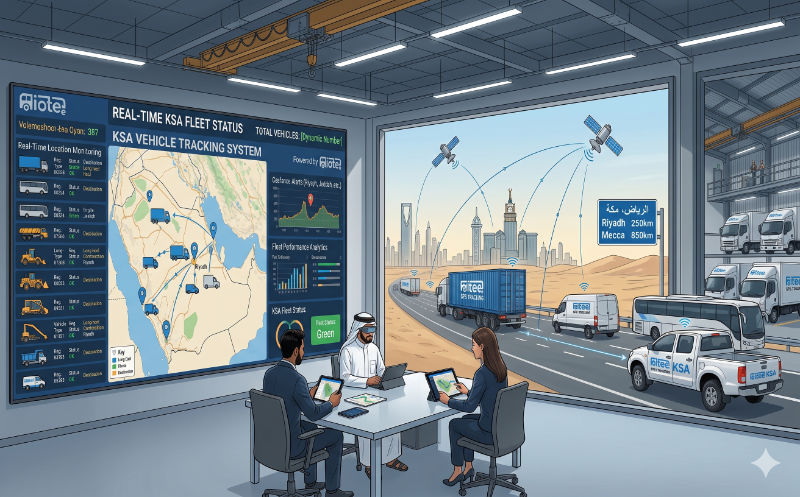
- Trip and route records: a time-stamped, GPS-tagged history of where each vehicle went and when — the backbone of any audit or dispute, captured by real-time GPS tracking.
- Speed and driving-behaviour evidence: proof that vehicles operated within speed limits and policy, complementing the speed limiter hardware many heavy vehicles must fit.
- Geofence and permitted-zone logs: confirmation that vehicles stayed within authorised areas and routes, using geofencing.
- Driver-hours and identity: who drove which vehicle and for how long, supporting fatigue and duty-hour discipline — see driver-behaviour monitoring.
- Exportable reports: the ability to hand an inspector or contractor a clean, dated report in minutes instead of reconstructing months of activity from memory.
The pattern across all of these is the same: the data an auditor asks for is data the fleet is already generating. A fleet that tracks its vehicles is not just recovering stolen assets or cutting fuel — it is quietly building the paper trail that makes every future inspection, contract tender and accreditation renewal faster and safer.
Building an audit-ready fleet: the records to keep
Whether the trigger is a TGA inspection, a Mawthooq-style accreditation review, a major-contract tender, or an insurance claim, the fleets that sail through are the ones that can produce records without a fire drill. Keep these current and retrievable:
- A live register of every vehicle with its operating card, Istimara and inspection expiry dates.
- A live register of every driver with licence class, any activity driver card, and renewal dates.
- Trip history per vehicle — routes, times and distances — retained for a sensible period.
- Speed and harsh-driving records showing operation within limits and policy.
- Maintenance and inspection history proving vehicles were roadworthy — the inspection guide covers what to retain.
- Incident records with location, time and, where available, footage for any accident or dispute.
The cost of non-compliance
The penalties for operating outside TGA rules are set by the authority and scale with the violation. Rather than quote figures that change, understand the categories of cost — they are what make compliance a clear commercial decision, not just a legal one.
- Fines: monetary penalties for operating without a valid licence or operating card, or for other breaches, escalating for repeat offences.
- Vehicle impound or being taken off the road: a stopped vehicle earns nothing and still costs — the downtime often dwarfs the fine.
- Suspension of the operating card or licence: which can halt part or all of an operation.
- Lost contracts: large shippers and government tenders increasingly require proof of compliance and accreditation; a lapse can disqualify you.
- Reputational and insurance impact: non-compliance surfaces in disputes and can complicate claims.
For the current, exact penalty schedule and fee amounts, consult the TGA directly — this guide deliberately avoids quoting numbers that the authority may revise.
What compliance-grade telematics costs in Saudi Arabia (2026)
TGA licences and operating-card fees are official charges set by the authority and paid to it — separate from any software. What a fleet spends to stay compliant is largely the telematics and fleet-management platform that tracks the dates and records. Typical 2026 KSA ranges:
| Tier | What it covers | Typical KSA price |
|---|---|---|
| Core tracking | GPS tracking, trip history, basic alerts | SAR 20–35 / vehicle / month |
| Fleet + compliance | Above + document/expiry tracking, driver records, reports | SAR 35–60 / vehicle / month |
| Advanced | Above + speed/behaviour analytics, geofencing, API/audit exports | SAR 60–90 / vehicle / month |
| Hardware (one-time) | Tracker device + professional installation | SAR 250–700 / vehicle |
| TGA official fees | Operator licence, operating cards, inspection | Set by the TGA — verify current amounts |
Set against the downtime of a single impounded vehicle or a lost contract, compliance-grade telematics is one of the cheaper forms of insurance a Saudi fleet can buy. It is most cost-effective when the same platform also drives your asset utilisation and maintenance, so a single subscription earns its keep several times over.
A practical TGA compliance checklist
- Confirm the exact transport activity your fleet performs and the licence it requires with the TGA.
- Verify the company holds a current commercial registration with that activity and a valid TGA operator licence.
- Audit every vehicle: valid operating card, current Istimara, passed periodic inspection, valid insurance.
- Audit every driver: correct licence class and any required activity driver card, all in date.
- Fit speed limiters and any tracking mandated for your activity, and confirm they report correctly.
- Load every expiry date into one platform with alerts weeks before each renewal.
- Confirm your telematics captures and exports trip, speed and geofence records for audits.
- Check current Mawthooq eligibility and requirements for your activity directly with the TGA, and act on any deadlines.
Make TGA compliance a background process
IOTee tracks operator, vehicle and driver expiry dates, captures the trip, speed and geofence records an audit needs, and exports them in minutes — on the same platform that tracks 320,000+ vehicles across the Kingdom. Book a free demo mapped to your activity.
Request a free demo →TGA fleet compliance across Saudi Arabia
IOTee helps operators stay audit-ready Kingdom-wide. Explore fleet management and real-time GPS tracking, or fleet support in Riyadh, Jeddah, Dammam, Makkah, Madinah and Khobar.