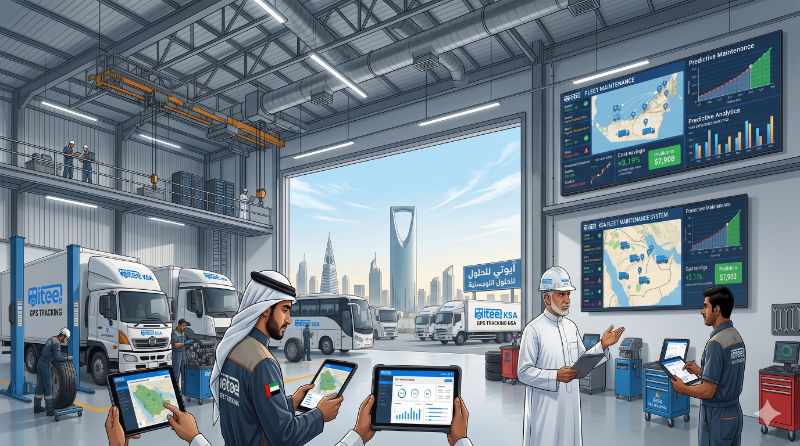
Moving pilgrims for Hajj and Umrah is one of the largest, most concentrated transport operations on earth. In a matter of days, fleets shuttle well over a million people between Makkah, the Mashaer sites of Mina, Arafat and Muzdalifah, Madinah, and the Jeddah and Madinah airports — on fixed corridors, to strict schedules, in summer heat, with essentially zero tolerance for a bus going missing or off-route. It is not ordinary fleet management scaled up; it is a distinct discipline where planning, route compliance and real-time visibility decide whether the operation is safe or chaotic.
This guide is for transport companies, Hajj and Umrah service operators, and fleet managers who run — or supply — pilgrim transport in the Kingdom. It covers what makes this fleet category unique, how route compliance works around the holy sites, how to plan capacity and scheduling for a demand spike that lasts days, how to track thousands of vehicles at once, and how to protect drivers in extreme heat. Throughout, the connective tissue is telematics: for the fundamentals of the underlying technology, see our guide to geofencing for Saudi fleets.
Why pilgrim transport is a fleet category of its own
A logistics fleet runs year-round on variable routes. A pilgrim-transport fleet does the opposite: it does most of its work in a compressed window, on a small number of tightly controlled corridors, carrying passengers whose safety is a national priority. That inversion changes every management decision.
- Extreme seasonality: demand is near-zero for much of the year, then peaks for the Hajj days and the Ramadan Umrah surge — you scale a fleet up and down by a large multiple, fast.
- Fixed, mandated corridors: movement between Makkah and the Mashaer sites follows assigned routes and a scheduled-flow (tafweej) plan, not driver choice.
- Passenger safety, not cargo: the load is people, so accident risk, driver fatigue and crowd-linked delays carry far higher stakes than a late delivery.
- Density and congestion: thousands of buses share the same roads in the same hours, so small delays cascade across the whole operation.
- Heat: when Hajj falls in summer, drivers and vehicles operate in some of the harshest conditions on the calendar.
- Heavy oversight: the Ministry of Hajj and Umrah, the Transport General Authority and the holy-sites authorities all expect demonstrable compliance and records.
The practical consequence is that you cannot run this fleet on the same loose, reactive basis a small local fleet gets away with. Every vehicle must be visible, every route enforced, and every movement recorded — which is exactly what a telematics platform is built to do. The same passenger-safety logic drives our school-bus tracking guide, at a smaller scale.
The Hajj and Umrah transport landscape in 2026
Pilgrim transport in the Kingdom is a regulated, multi-party system. Understanding who does what tells you where a fleet operator sits and what it must prove.
- Ministry of Hajj and Umrah: sets policy, licenses service providers, and drives the digital transformation of the pilgrim journey through the Nusuk platform.
- Transport General Authority (TGA): regulates commercial passenger transport — operator licensing, vehicle operating cards, and safety standards that pilgrim fleets must meet.
- Authorised transport companies: the operators that actually own and run the buses, contracted to move pilgrims between arrival points, accommodation and the holy sites.
- Holy-sites and traffic authorities: manage the corridors, the tafweej schedule and the Mashaer area movement, including the Mashaer metro that carries part of the load.
- Hajj and Umrah service companies (and Nusuk): package and coordinate the pilgrim experience, of which ground transport is a critical component.
For a fleet operator, the takeaway is that you are accountable to several bodies at once, and the currency of that accountability is data: where your vehicles were, whether they stayed on route, how fast they travelled, and whether services ran to schedule. A modern fleet management platform turns that from a manual scramble into an exportable record.
Route compliance and the Mashaer corridors
The single most important operational control in Hajj transport is keeping buses on their assigned corridors and moving in the correct sequence. With hundreds of thousands of people flowing between Mina, Arafat and Muzdalifah in narrow time windows, an off-route or out-of-sequence bus is not a minor inconvenience — it disrupts the whole tafweej plan.
This is where geofencing earns its place. You draw the assigned routes, staging yards, camp zones and holy-site boundaries as digital fences, and the system alerts the moment a vehicle leaves its corridor, enters a zone it should not, or misses a scheduled departure. Combined with live tracking, dispatch can correct a straying bus in real time rather than discovering the problem after pilgrims are stranded.
- Corridor enforcement: geofenced routes flag any deviation from the assigned Makkah–Mashaer path immediately.
- Zone control: staging areas, camp zones and drop-off points as geofences confirm vehicles reach and leave the right places on time.
- Schedule adherence: the tafweej plan depends on departures happening in the right sequence; tracking shows which buses are running late before the delay spreads.
- Speed limits on corridors: pilgrim corridors have strict speed limits; telematics enforces and logs them, complementing the mandatory speed-limiter rules for buses.
Capacity, scheduling and utilisation at peak
The defining challenge of pilgrim transport is matching a large, temporary supply of vehicles and drivers to a demand curve that spikes for a few days and then collapses. Get it wrong in one direction and pilgrims wait; wrong in the other and you pay for idle buses and drivers.
| Phase | Demand pattern | Fleet priority |
|---|---|---|
| Off-season | Low, steady Umrah traffic | Maintenance, driver training, system setup and dry-runs |
| Ramadan Umrah surge | Sustained high demand for weeks | Utilisation, driver-hours management, schedule reliability |
| Pre-Hajj build-up | Rising arrivals into Jeddah and Madinah | Airport-to-Makkah/Madinah transfers, staging readiness |
| Hajj peak (Mashaer days) | Extreme, compressed, corridor-bound | Route compliance, real-time control, driver welfare |
| Departure phase | High outbound to airports | Reverse logistics, on-time airport transfers |
Telematics data is what makes each phase manageable. Utilisation reports show whether buses are working or idle; driver-hours records keep shift patterns safe and legal; and historical GPS data from one season becomes the planning model for the next — how long a corridor run actually takes, where the choke points are, and how many vehicles a route really needs.
Planning from last season’s data
The most valuable asset a returning operator has is the previous season’s trip history. Real journey times, dwell times at staging yards, and congestion patterns — captured automatically by the tracking system — let you plan the next Hajj on evidence instead of guesswork. Fleets that throw that data away each year keep re-learning the same lessons.
Real-time tracking at scale
Tracking one bus is trivial; keeping situational awareness of thousands at once, in dense corridors, is the real test. At Hajj scale the platform, not just the device, has to hold up.
- Fleet-wide live map: every vehicle’s position on one screen, filterable by route, operator or status, so a control room sees the whole operation at a glance.
- Exception-based alerts: at this scale no one can watch every bus, so the system must surface only what is wrong — off-route, over-speed, stopped too long, or missed a departure.
- Reliable coverage: tracking must keep working in congested, high-density areas where networks are strained; devices should buffer and sync so no trip data is lost.
- Dispatch and communication: two-way contact with drivers and the ability to re-task the nearest available bus when plans change.
- Instant reporting: the ability to produce a route-and-timing report for any vehicle, on demand, for the authorities or the service company.
The platform’s job at peak is to turn an overwhelming volume of movement into a short list of things that need a human decision. That is only possible when tracking, geofencing and alerting run together on one system — read how the pieces fit in our real-time GPS tracking overview.
Driver welfare and safety in the heat
Pilgrim safety starts with driver safety, and Hajj concentrates every fatigue risk at once: long shifts, dense traffic, disrupted sleep, and — in summer Hajj years — punishing heat. A tired driver of a full bus is the single largest risk in the operation, and it is a manageable one.
- Driver-hours management: tracking logs actual driving time so shift limits are enforced and rotations planned, not left to chance at 2am on a Mashaer run.
- Fatigue and distraction monitoring: AI cameras and behaviour scoring catch drowsiness and harsh events; see our guide to driver behaviour monitoring.
- Speed and harsh-event control: smoother, slower driving on crowded corridors reduces both accident risk and passenger discomfort.
- Vehicle readiness in heat: pre-season maintenance of cooling systems, tyres and brakes matters more when ambient temperatures are extreme and buses run near capacity all day.
- In-cab support: clear routing and dispatch reduce the stress and improvisation that lead to mistakes in unfamiliar, crowded conditions.
What pilgrim-fleet telematics costs (2026)
Telematics for pilgrim fleets is priced per vehicle per month, usually with a one-time hardware and installation cost, and often scaled for the seasonal nature of the fleet. These are indicative 2026 ranges in the Kingdom, not quotes.
| Tier | What you get | Typical KSA price |
|---|---|---|
| Core tracking | Live GPS, geofencing, speed and route alerts, basic reports | SAR 20–45 / vehicle / month |
| Passenger-transport package | Above + driver-hours, schedule adherence, control-room dashboard | SAR 45–90 / vehicle / month |
| Safety-enhanced | Above + AI dashcam / driver monitoring and in-cab alerts | SAR 90–160 / vehicle / month |
| Hardware (one-time) | Tracker, install, and where fitted, camera hardware | SAR 300–1,800 per vehicle |
Actual cost depends on fleet size, how much of the year the vehicles operate, and whether cameras are included. For a seasonal operator, ask specifically about flexible or seasonal billing, and confirm that the hardware and dashboards you configure for one Hajj carry over to the next without re-work.
Compliance, records and the authorities
Pilgrim transport is heavily regulated, and the operators who keep their licences are the ones who can prove compliance on demand. The specifics of programs and fees change, so confirm current requirements with the Ministry of Hajj and Umrah and the TGA — but the categories of what you must demonstrate are stable.
- Licensed operation: a valid TGA operator licence and per-vehicle operating cards for commercial passenger transport.
- Vehicle roadworthiness: current registration (Istimara) and periodic inspection (Fahas / MVPI) for every bus in service.
- Qualified drivers: properly licensed drivers, with hours managed within legal and safe limits.
- Route and speed records: demonstrable proof that vehicles stayed on assigned corridors and within speed limits — exactly what geofence and speed logs provide.
- Auditable trip history: the ability to produce a time-stamped movement record for any vehicle across the season.
This is where telematics quietly does its most important work: it converts every requirement above into a record that already exists, rather than a report someone has to reconstruct after the fact. When an authority asks where a bus was at a given hour, the answer is a query, not an investigation.
Preparing your fleet: a pre-season checklist
- Confirm every vehicle has a working tracker and, where required, a camera — installed and tested before the season, not during it.
- Build and verify geofences for all assigned corridors, staging yards, camp zones and holy-site boundaries.
- Set alert rules: off-route, over-speed, missed departure, and excessive stop time — tuned so the control room sees signal, not noise.
- Load driver records and configure driver-hours limits and shift rotations.
- Complete pre-season maintenance on cooling, tyres and brakes, prioritised by each bus’s expected duty in the heat.
- Dry-run the whole system on Umrah traffic and fix what breaks before Hajj scale hits.
- Brief the control room on exception-based monitoring and dispatch escalation.
- Confirm you can export a route-and-timing report for any vehicle on demand for the authorities.
Run your pilgrim fleet on one platform this season
IOTee provides real-time tracking, corridor geofencing, driver-hours management and instant audit reports for passenger fleets across the Kingdom — Arabic-first and built for scale. Book a free demo and we will map it to your Hajj and Umrah operation.
Request a free demo →Pilgrim transport and fleet operations across Saudi Arabia
IOTee supports passenger and pilgrim fleets Kingdom-wide. Explore our fleet management and real-time GPS tracking services, or local fleet support in Makkah, Madinah, Jeddah, Riyadh, Dammam and Khobar.