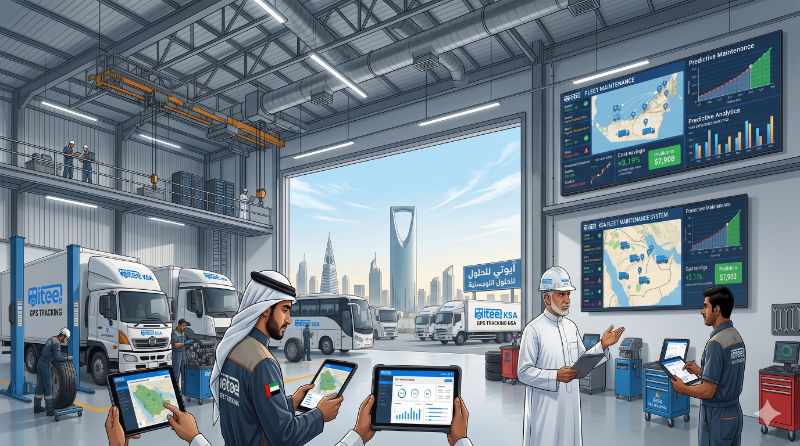
An idle excavator on a Riyadh megaproject still costs money every hour it sits — in finance, in rental, in an operator on the clock — but earns nothing. A stolen loader can be across a provincial border before the site foreman notices it is gone. In Saudi Arabia in 2026, with Vision 2030 driving the largest construction programme in the region, knowing where every machine is, how many hours it has actually worked, and whether it has left its site is no longer a nice-to-have. Heavy equipment GPS tracking is the system that turns a yard full of assets into a fleet you can measure, bill and protect.
This guide is about tracking construction and heavy equipment specifically — excavators, loaders, dozers, cranes, generators, light towers — not road vehicles. The rules are different: you measure engine hours, not kilometres; assets sit on remote off-grid sites; and many of them have no ignition or power of their own. It covers what you can track, how engine-hour billing works, how theft recovery plays out in the Kingdom, the hardware for powered and unpowered assets, real SAR pricing, and how to choose. For the underlying platform, see our vehicle tracking system guide.
What is heavy equipment tracking?
Heavy equipment tracking (also called plant or asset tracking) is the use of GPS devices and telematics to monitor construction machinery and site assets. Each asset carries a device that reports its location and, on powered machines, its engine hours, fuel level, ignition state and diagnostic data. The data lands in the same kind of platform used for real-time GPS tracking of vehicles, but the reports and rules are built around how equipment is actually used.
Two kinds of asset: powered and unpowered
The assets fall into two broad groups. Powered, engine-driven machines — excavators, wheel loaders, dozers, backhoes, telehandlers, cranes — where you can read engine hours and often fuel and fault codes directly. And unpowered or intermittently powered assets — generators, light towers, welding sets, containers, compactors, portable tanks — which need a self-powered tracker with a long battery or a small solar panel, because there is no vehicle electrical system to draw from.
Why equipment tracking is not just vehicle tracking
Fleets that already run vehicle GPS sometimes assume equipment is the same job. It is not, and the differences decide which platform and hardware you need.
- Engine hours, not kilometres: a stationary excavator can work all day without moving a metre. Utilization, billing and maintenance are all measured in engine hours, so the device must read hour-meter or run-time data — distance is nearly meaningless.
- Off-grid, low-signal sites: machines work in pits, remote desert sites and the early phases of a megaproject where there is no infrastructure. Devices need good cellular coverage handling and store-and-forward when signal drops.
- No ignition on many assets: a generator or light tower has no key to sense. Detecting "in use" means reading vibration, a voltage line, or a run signal — not an ignition wire.
- Self-powered trackers: unpowered assets cannot draw from a battery that is being charged by an alternator, so they need long-life battery or solar trackers that report less often to survive months in the field.
- Harsh conditions: heat above 50°C in summer, dust, vibration and washdowns. Equipment devices must be ruggedised and sealed to a high IP rating, well beyond a plug-in car tracker.
- Ownership mix: owned, rented-in and rented-out machines coexist on one site, and the platform has to attribute hours and costs correctly across all three.
What you can track on a machine
How much you can see depends on the asset and how the device connects — a simple location beacon on a container, or a full CAN/J1939 read on a modern excavator.
| Data | How it is captured | What it is used for |
|---|---|---|
| Location | GPS on every device | Find assets, confirm site, recover theft |
| Engine hours | Hour-meter, run-time or CAN/J1939 bus | Utilization, rental billing, maintenance intervals |
| Ignition / in-use | Ignition wire, voltage or vibration sensor | Idle vs working time, after-hours use alerts |
| Fuel level | CAN bus or a fuel-level sensor | Detect theft, plan refuelling, spot waste |
| Fault codes (DTCs) | CAN/J1939 diagnostic read | Predict failures, cut breakdowns |
| Geofence events | Software zone around each site | Alert when an asset leaves or enters a site |
The single most valuable field is engine hours. It drives three of the biggest use cases — utilization, billing and maintenance — and it is the number that is most often wrong when tracked by hand on a paper log or a photo of an hour-meter.
Utilization and engine-hour billing
The most direct money case for equipment tracking is utilization. On most sites a meaningful share of machines are underused — sitting idle, double-booked, or forgotten in a corner of the yard while a second unit is rented in to do the same job. Accurate engine-hour data exposes exactly which assets earn their keep and which should be moved, sold or off-hired.
- Idle vs working hours: separate genuine working time from an engine left running for the air conditioning, which in Saudi heat can be a large share of fuel burn — see our fuel monitoring guide for the same problem on vehicles.
- Right-sizing the fleet: if ten machines run at 40% utilization, you may be paying to own or rent three you do not need.
- Rental billing: for equipment rented out, engine hours become the invoice. The platform logs verified hours per machine per customer, so billing is based on data both sides can see, not a disputed timesheet.
- Cost per hour: combine hours with fuel and maintenance to get a true cost per operating hour, the number that drives buy, rent, repair or replace decisions.
Theft prevention and recovery on Saudi megaprojects
Heavy equipment is a high-value, mobile target, and the scale of Vision 2030 construction — NEOM, Qiddiya, the Red Sea developments, Diriyah, King Salman Park and countless smaller sites — means more machines spread across more remote locations than ever. Tracking is the difference between a total loss and a fast recovery.
- Site geofences: draw a zone around each site with geofencing; if an asset crosses it outside working hours, dispatch and the site manager get an instant alert.
- After-hours movement alerts: a machine that starts or moves at 02:00 on a Friday is the earliest theft signal there is.
- Remote immobilization: on suitable powered machines, an immobilizer can prevent the engine from being restarted once it is safely stopped, holding the asset until it is recovered.
- Hidden, self-powered backup tracker: a second concealed tracker survives if the main unit is found and removed, and keeps reporting for recovery.
- Recovery coordination: live location gives the owner and police an exact position, which is what turns an alert into a recovered machine rather than an insurance write-off.
Maintenance by real engine hours
Construction machinery is serviced by engine hours — the 250, 500 and 1,000-hour intervals in the manufacturer's schedule. Tracked correctly, those intervals fire from the machine's real run-time, so service happens on time without a manager reading hour-meters around the yard. In Saudi conditions — extreme heat, fine dust that destroys filters, hard duty cycles — sticking to hour-based service is what keeps expensive machines out of unplanned downtime.
The strongest setups feed engine hours and fault codes straight into a maintenance module, so a service work order opens automatically at the interval and a diagnostic fault raises a ticket before it becomes a failure. This is the same logic as vehicle maintenance; see our complete fleet maintenance guide for Saudi Arabia and the fleet maintenance service.
Hardware for powered and unpowered assets
Choosing the right device per asset type is the decision that makes or breaks an equipment-tracking rollout. There is no single tracker for a 40-tonne excavator and a portable light tower.
| Device type | Best for | Notes |
|---|---|---|
| Hardwired + CAN/J1939 | Modern powered machines (excavators, loaders, cranes) | Reads engine hours, fuel and fault codes directly; permanent power |
| Hardwired basic | Older powered machines without a data bus | Location, ignition and hour-meter via run-time; no CAN data |
| Solar asset tracker | Unpowered outdoor assets (light towers, tanks, containers) | Self-charging; reports a few times a day to save power |
| Long-life battery tracker | Assets stored or moved often, no sun exposure | Battery lasts months to years at low reporting frequency |
| Hidden backup tracker | High-value machines at theft risk | Concealed, self-powered second unit for recovery |
All of these must be ruggedised for Saudi field conditions: a high IP rating against dust and water, a wide operating-temperature range for 50°C-plus summers, and vibration resistance. A consumer-grade tracker that works fine in a car will fail quickly on a dozer.
What equipment tracking costs in Saudi Arabia (2026)
Equipment tracking in the Kingdom is priced as a one-time device per asset plus a monthly subscription. The device cost varies most, because powered and unpowered assets need different hardware. Below are typical 2026 ranges; get a written quote for your asset mix.
| Item | What it covers | Typical KSA price |
|---|---|---|
| Hardwired device | Powered machine, install included | SAR 200–450 per asset (one-time) |
| Solar / long-life tracker | Unpowered asset, self-powered | SAR 300–700 per asset (one-time) |
| Monthly subscription | Platform, data SIM, support | SAR 15–45 per asset / month |
| CAN/J1939 integration | Deep engine, fuel and fault-code read | May add to device or subscription tier |
| Immobilizer add-on | Remote engine-restart prevention | SAR 150–400 per asset (one-time) |
The return comes from three lines: recovered utilization (fewer idle and duplicate machines), captured billing (verified rental hours), and avoided losses (theft and unplanned breakdowns). For the fuller way to frame that payback, read our GPS tracking ROI guide for Saudi fleets.
Vision 2030, conditions and local considerations
Equipment tracking in Saudi Arabia has to fit the environment and the market it operates in, not just work in principle.
- Vision 2030 megaproject scale: the giga-projects run thousands of machines across vast, phased sites; asset visibility, site-by-site geofencing and utilization reporting are operational necessities at that scale, not extras.
- Heat and dust: summer temperatures and fine desert dust punish both machines and devices; ruggedised, sealed hardware and hour-based maintenance are non-negotiable.
- Remote, infrastructure-light sites: early-phase megaproject sites and desert works have limited connectivity; devices with store-and-forward and good roaming SIMs matter.
- Rental market: a large share of Saudi plant is rented; verified engine-hour billing and clear owned-vs-rented attribution are central, not optional.
- Insurance and recovery: tracking supports insurance requirements and materially improves recovery odds, which can affect premiums and claims.
- Data handling: asset and site location data should be handled in line with Saudi data-protection expectations; prefer platforms with clear data terms and local hosting.
How to choose and roll out equipment tracking
Once you know your asset mix, the choice comes down to a short checklist. Pilot it on one site before you fit the whole fleet.
- Confirm it reads engine hours accurately on your machines — via CAN/J1939 where possible, run-time where not.
- Check it supports both powered devices and self-powered solar/battery trackers for unpowered assets.
- Verify the hardware is ruggedised and rated for 50°C-plus heat, dust and vibration.
- Require per-site geofencing with after-hours movement and loss-of-signal alerts.
- Ask how the solution behaves under a GPS/GSM jammer, and whether a hidden backup tracker and immobilizer are available.
- Confirm utilization and engine-hour billing reports, with owned-vs-rented attribution.
- Check maintenance scheduling by engine hours and fault codes is built in or integrates cleanly.
- Get device and subscription pricing per asset type in writing, and run a 30-day pilot on one site.
- Days 1–7 — Register assets: load every machine and asset with its type, serial/plate, owner or rental status and current hour-meter reading.
- Days 8–14 — Fit and verify: install hardwired devices on powered machines and solar/battery trackers on unpowered assets; confirm engine hours read correctly.
- Days 15–21 — Set geofences and alerts: draw each site zone, enable after-hours and loss-of-signal alerts, and test recovery workflow.
- Days 22–26 — Turn on utilization and billing: verify hours against known usage and reconcile a rental invoice from the data.
- Days 27–30 — Scale out: fit the rest of the fleet, set the weekly utilization and maintenance review, and assign owners for alerts.
See heavy equipment tracking built for Saudi sites
IOTee tracks powered and unpowered assets, reads engine hours, runs site geofences, immobilization and hour-based maintenance on one platform across the Kingdom. Book a free demo and we will map it to your equipment fleet.
Request a free demo →Heavy equipment tracking across Saudi Arabia
IOTee deploys equipment and fleet tracking together, Kingdom-wide. Explore real-time GPS tracking and fleet maintenance, or asset-tracking support in Riyadh, Jeddah, Dammam, Makkah, Madinah and Khobar.